 Share with the world 🙏
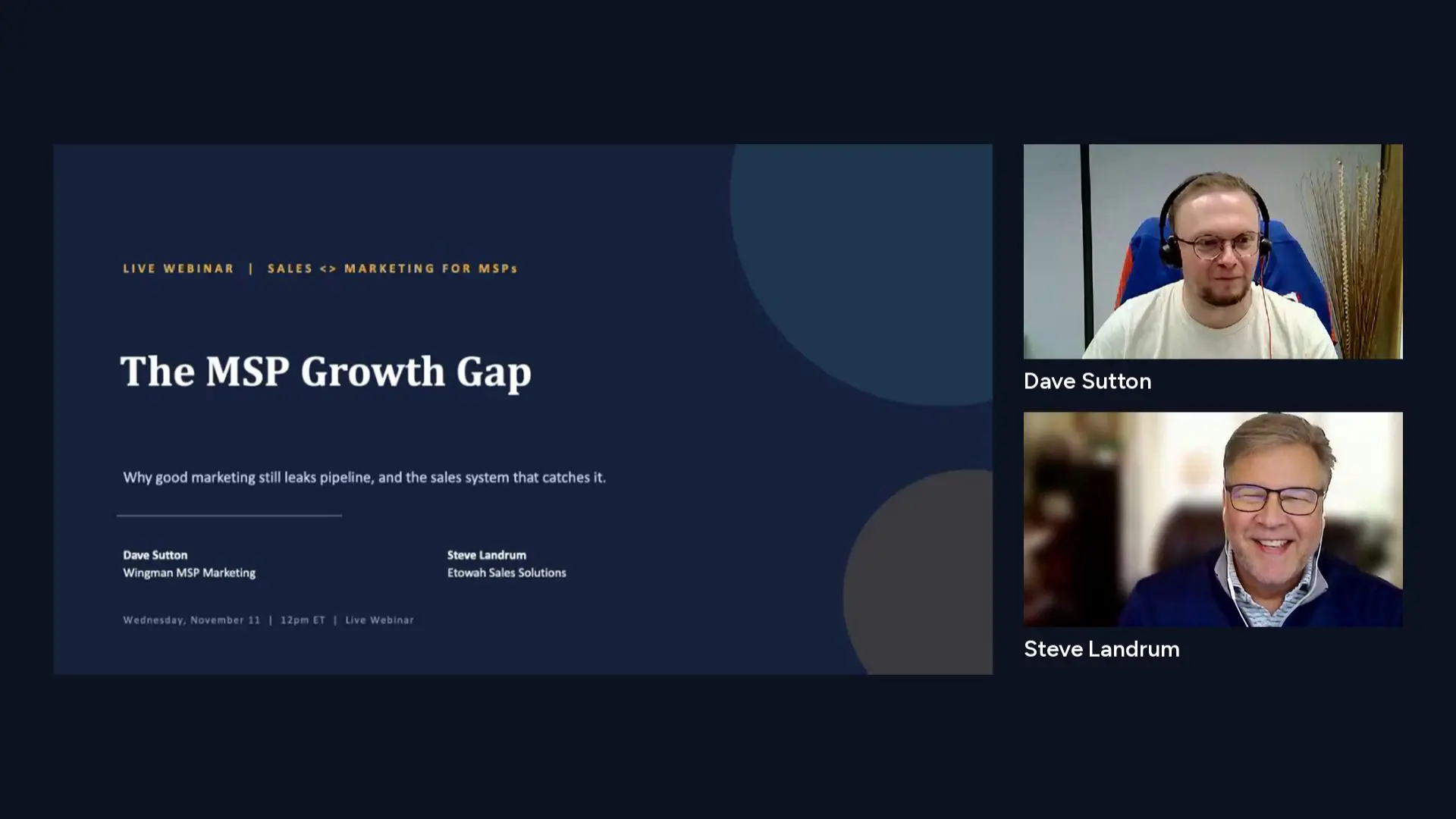
Last week, Dave sat down with sales consultant Steve Landrum for The MSP Growth Gap: When Sales Meets Marketing. Dave spent a decade selling for MSPs before founding Wingman. Steve is an engineer by training who has built and led sales teams throughout his career, and for the last six years has helped MSPs put proper sales systems in place.
Their starting point: most MSPs grew on referrals, and that has shaped how they think about new business. Marketing gets treated as a silver bullet that should deliver referral-quality leads on tap. Sales, meanwhile, often has no process to handle what marketing creates. That disconnect is the growth gap.
Here are the key lessons. You can watch the full recording here.
Referrals have set the wrong expectation
A referred prospect arrives already warm. Someone they trust has vouched for you, so the deal is almost yours to lose. Dave describes it as a “trust thermometer”: referrals start about two-thirds of the way up.
Cold prospects start at the bottom. They don’t know you, they don’t trust you yet, and most aren’t ready to buy. That’s why Dave prefers to talk about conversations rather than leads. Marketing’s job is to start those early conversations and build trust until someone is ready to talk.
From casting a net to spear fishing
Outbound used to be a numbers game. Call enough people and a few would make the right noises. Since COVID, remote working and unanswered phones have made that approach far less effective.
The better approach is to focus sales effort on people who have already engaged with you. They’ve opened your emails, visited your website, read your content or connected on LinkedIn. As Steve put it, technology helps you find the interested people, but you still have to do something with them.
Build a catcher’s mitt
Steve’s analogy stuck with everyone. Your marketing can throw great fast balls, but without a catcher’s mitt they go nowhere. You need a defined process for what happens to an enquiry when it arrives: who follows it up, how it’s recorded and what the next step is, all the way to the win.
Why would anyone talk to you?
Most of your prospects already have an MSP. Even if trust has slipped, the hassle of switching usually keeps them where they are. Something has to trigger a move, and in managed services it’s often a project: an office move, a server reaching end of life, a contract renewal or a serious outage.
The project gets you in the door and managed services follow. But you need to be visible and trusted before that trigger happens. That means:
- Dropping the free network assessment. Dave believes it’s dead. People don’t value what’s free, and they see it as a sales tactic.
- Using stepping-stone offers. You wouldn’t propose on a first date, so don’t jump straight to an MSA. A paid AI readiness gap analysis (security, compliance, Microsoft 365 permissions) delivers real value and raises trust before a bigger commitment.
- Translating vendor messaging into customer outcomes. Big-picture vendor narratives rarely land with end customers. Talk about the hours of admin time a workflow saves, or the billable hours a law firm gets back.
- Keeping the human touch. AI makes average content easy to produce. Show your people, your team and your office so you stand out from invisible competitors.
Education wins deals
Steve shared research from RAIN Group, which asked B2B buyers why they chose the seller they bought from. The top reason: the seller educated them with new ideas. Next came “they collaborated with me” and “they listened to me”. Or, as Steve puts it, two ears and one mouth, used in that ratio.
Education builds trust, and trust builds the relationship. Steve added that keeping it visual matters. ROI shown as a simple picture beats a complicated spreadsheet, and your proposal should sell for you when you’re not in the room.
The state of sales: you’re not alone
Steve shared findings from a survey of 5,263 business leaders. Across industries, businesses rated themselves poor in these areas:
Area | Rated poor |
|---|---|
Can’t communicate their unique value (owners) | 87% |
Don’t know what needs to happen at each sales stage | 83% |
Sales methodology | 79% |
No defined sales process | 73% |
No onboarding plan for new sales hires | 73% |
Sales analysis and metrics | 72% |
Hiring and sales organisation | 70% |
Targeting the ideal client profile | 58% |
Sales process not documented (where one exists) | 57% |
Sales strategy | 54% |
Both Dave and Steve suspect MSPs score worse than average. Many MSPs tell us they’re “the same as everyone else”. The stack may be similar, but the way you deliver and the stories you can tell are not. MSPs just rarely recognise their own impact.
One revenue engine, not two departments
Sales and marketing work best as one revenue engine. Tracking now makes that possible. Dave shared an example from one of our US clients: a prospect had around 15 tracked touchpoints over 10 to 12 weeks, including emails, direct website visits and a search ad. When the sales rep got in touch and referenced what they’d been reading, the prospect said they were ready for a conversation.
The other half is planning from your goals. If you want four new clients and convert one in four non-referral opportunities, you need 16 qualified opportunities. Work back up the funnel from there to see how many people you need to reach. Focusing on an industry niche or a specific service can make far more of that audience engage.
Follow up properly, and focus
Not every lead deserves chasing. If it’s outside your ideal client profile, it’s wasted time and money.
The bigger problem in MSPs is the opposite. Dave reviewed one client’s pipeline and found genuine enquiries where the rep sent two emails and gave up. No phone call, no LinkedIn connection. Steve sees passive follow-up far more often than over-aggressive selling. If someone has enquired, you’ve earned the right to pick up the phone.
Look beyond the win
Once a client signs, it’s easy to stop selling. Turn happy clients into advocates, ask for testimonials and look for upsell opportunities through proper account management.
Dave shared an exercise from his MSP days: plot your clients on profit versus pain. Low-profit, high-pain clients may need to go. High-profit, low-pain clients are the profile you want more of.
Get the people side right
Too many businesses hire salespeople with no plan, then put them in the field within days with no onboarding. Steve recommends a structured hiring process and a proper onboarding plan for the first few weeks.
Dave also made the case for the “reluctant salesperson”. Many senior techs say they couldn’t sell, yet love helping people solve problems. That is what sales is. Test for aptitude, then give them the structure to succeed. And remember, as an MSP you already understand outsourcing. The right partners can fill gaps faster than hiring.
Key takeaways
- Earn the conversation through education, not pitching.
- Build a sales process that catches and converts what marketing creates.
- Know your numbers and plan back from your goals.
- Follow up with persistence across phone, email and LinkedIn.
- Treat sales and marketing as one revenue engine.
As Steve summed it up, sales is too often the most unstructured process in a business. Bring structure to it, and results follow.